 |
 |
 |
 |
 |
||
 |
 |
 |
 |
 |
 |
 |
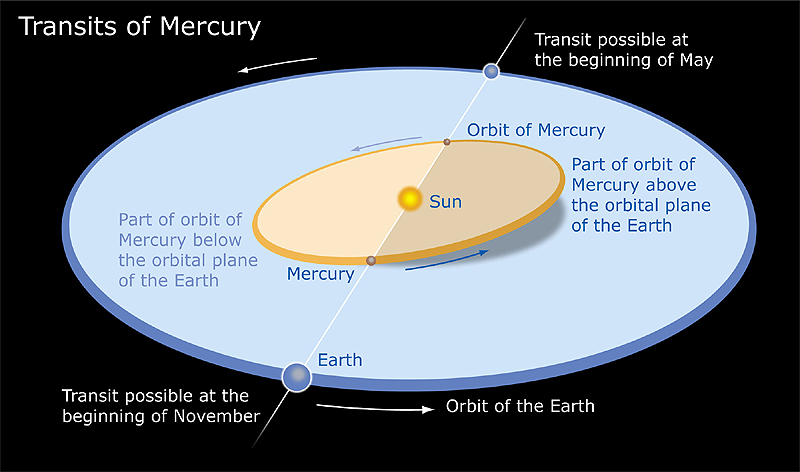
On May 9, 2016 Mercury will across the face of the Sun for only the second time this century. Mercury's orbit is highly eccentric (eliptical or oval). This causes the little planet's distance from the Sun to vary from 46 to 70 million kilometers. At perihelion (the closest point in its orbit to the Sun) Mercury's orbital velocity (59.0 km/sec) is over 50% faster than it is at aphelion (its farest point in its orbit from the Sun) (38.9 km/sec). Furthermore, the planet's orbit is tipped 7 degrees to Earth's around the Sun. Such a wildly varying and inclined orbit has important consequences on the characteristics and frequency of Mercury's transits.
Due to Mercury's close proximity to the Sun, the orbit of the planet shifts a bit due to the effects of general relativity.

If the transit occurs in the month of May, Mercury appears to be 1/158 the size of the Sun. In contrast, during November transits Mercury appears to be 1/194 the size of the Sun.
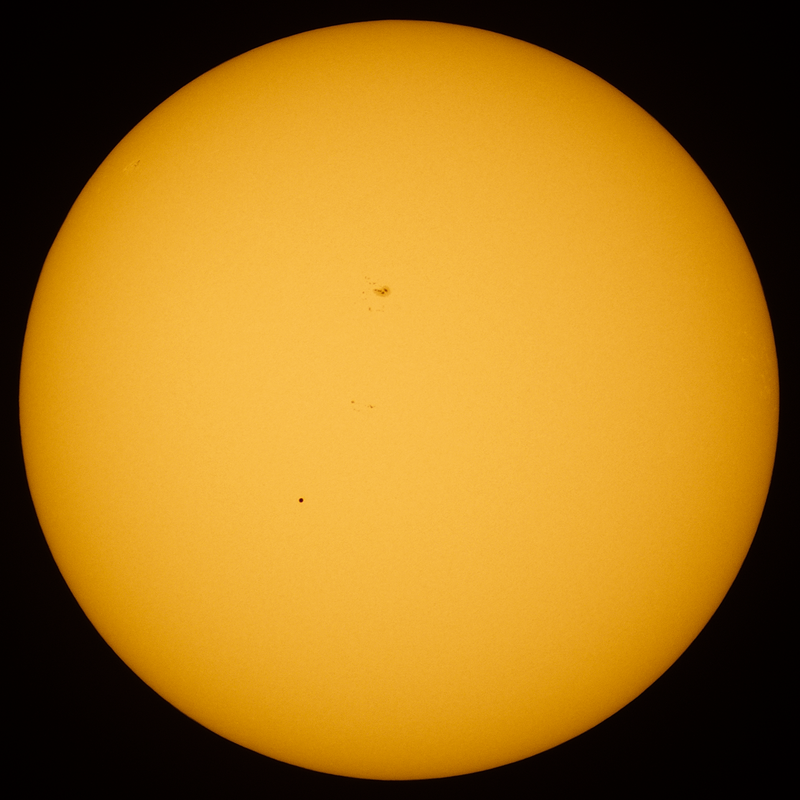
2016 Mercury Transit
The first observation of a transit of Mercury was on November 7, 1631 by Pierre Gassendi. Johannes Kepler had however predicted the occurrence of transits of Mercury and Venus some time before that. Gassendi unsuccessfully attempted to observe the transit of Venus just one month later, but due to inaccurate astronomical tables he did not realize that it was not visible from most of Europe, including Paris. A transit of Venus was not observed until 1639, by Jeremiah Hor rocks.
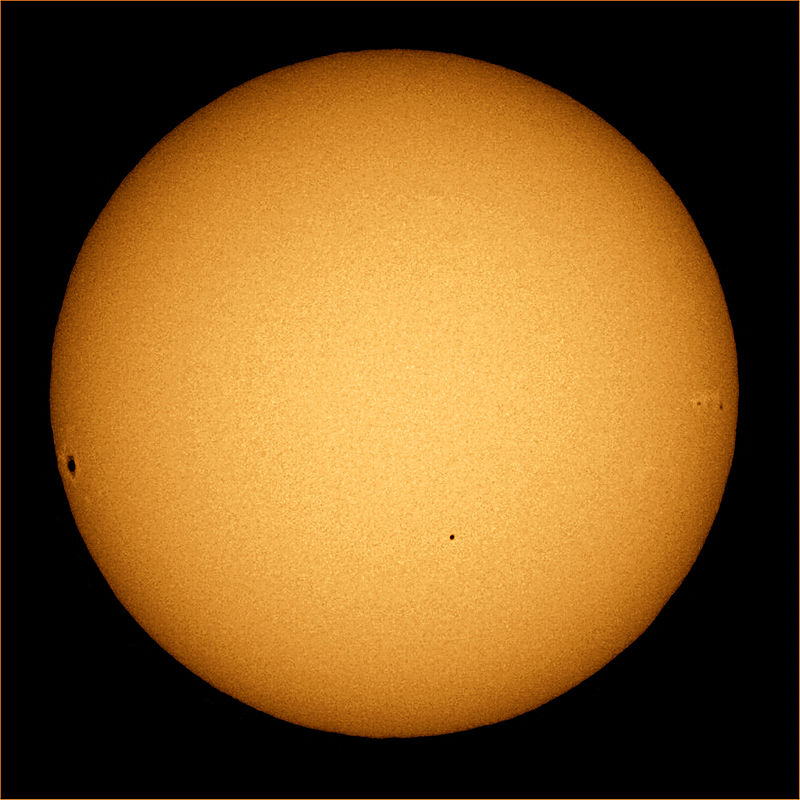
2006 Mercury Transit
While Mercury passes in front of the Earth about every 95 days, the orbit of Mercury is inclined ( by about 7 degrees) relative to the Earth. Most of the time Mercury passes above or below the Sun as viewed from Earth during these conjunctions.
Scientists are currently using a 'transit method' to detect planets around distant stars. When the alignment of a distant star system and Earth is nearly edge-on, scientists can detect and measure the dip as a planet blocks a fraction of the starlight. Learn more about the detection of extra-solar planets at the Kepler Space Telescope website.
|
|
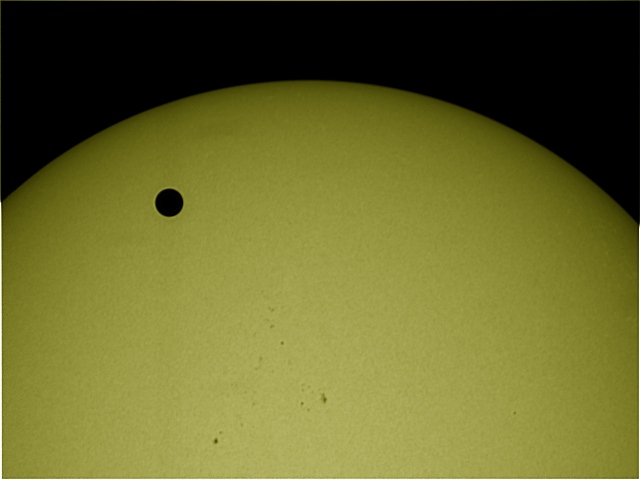
Venus transit from Oliver Lee State Park through 90mm f/10 refractor, Lunt solar wedge, Baader 532 nm filter and IS DMK41AU02 camera |
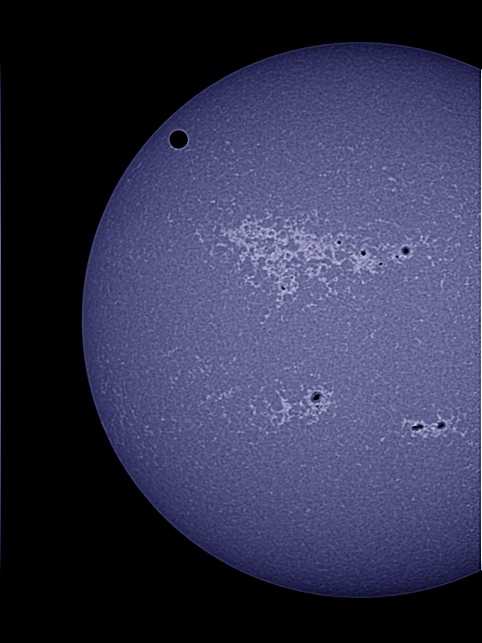
Venus transit from Oliver Lee State Park through a Stellarvue SV80ED, Lunt B1200 Calcium-K module and DMK41AU02 camera |
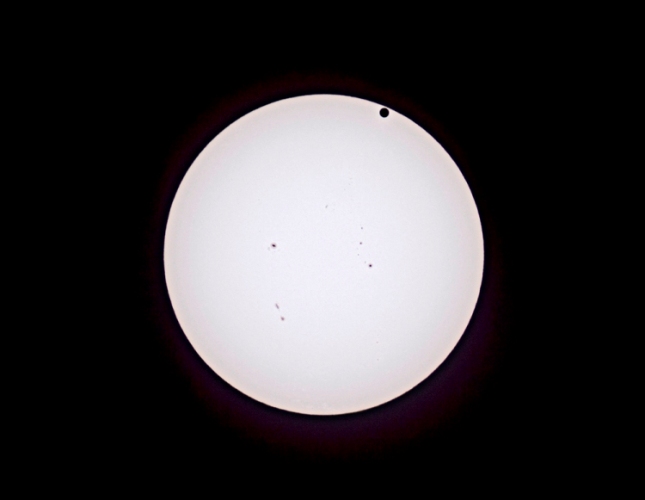
Venus transit from Cloudcroft NM through a Televue TV85 refractor, baader solar film and a Canon DSLR just after the 2nd ingress contact point |
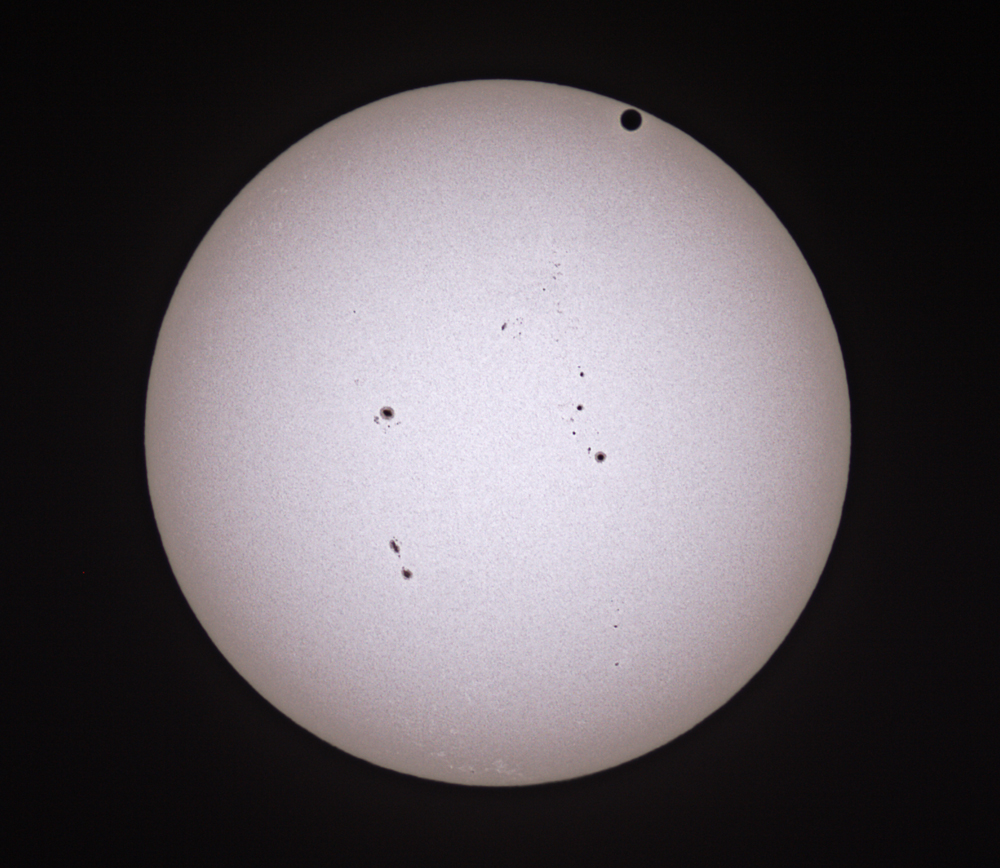
Another Venus transit from Cloudcroft with a TV85, additional processing brought out the sunspots |
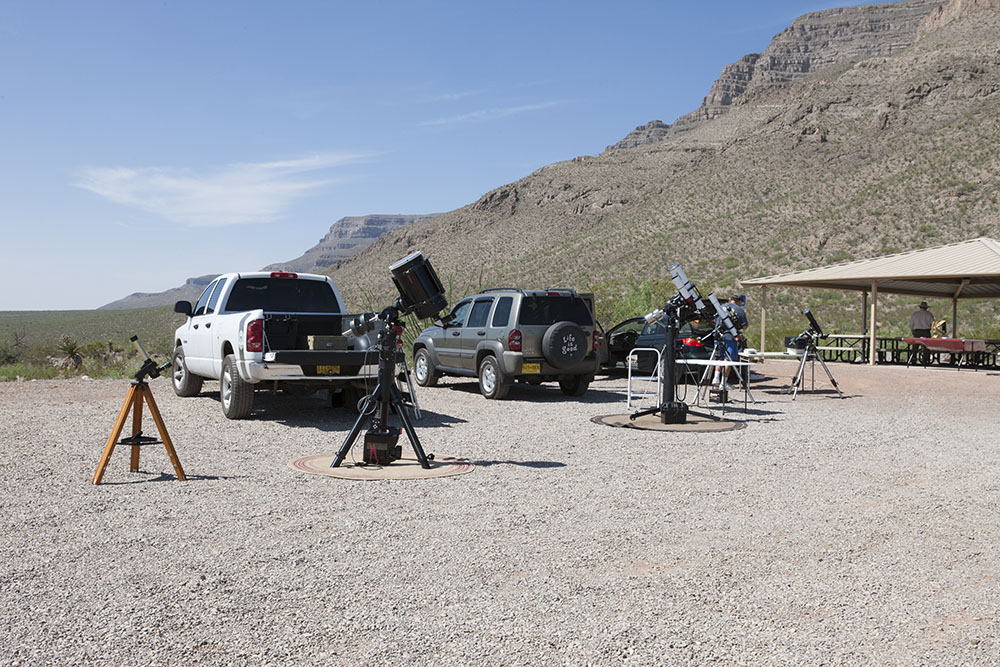
Venus transit star party (06/05/2012) at Oliver Lee State Park prior to the crowd arrival |
|||||||